Loading, please wait...
Pickleball
Best Cold-Weather Pickleballs: 3 Options Worth Comparing
Compare ONIX Fuse G2, Selkirk Pro S1, and GAMMA CHUCK for cooler outdoor play, including warranty limits and five buying mistakes to avoid.
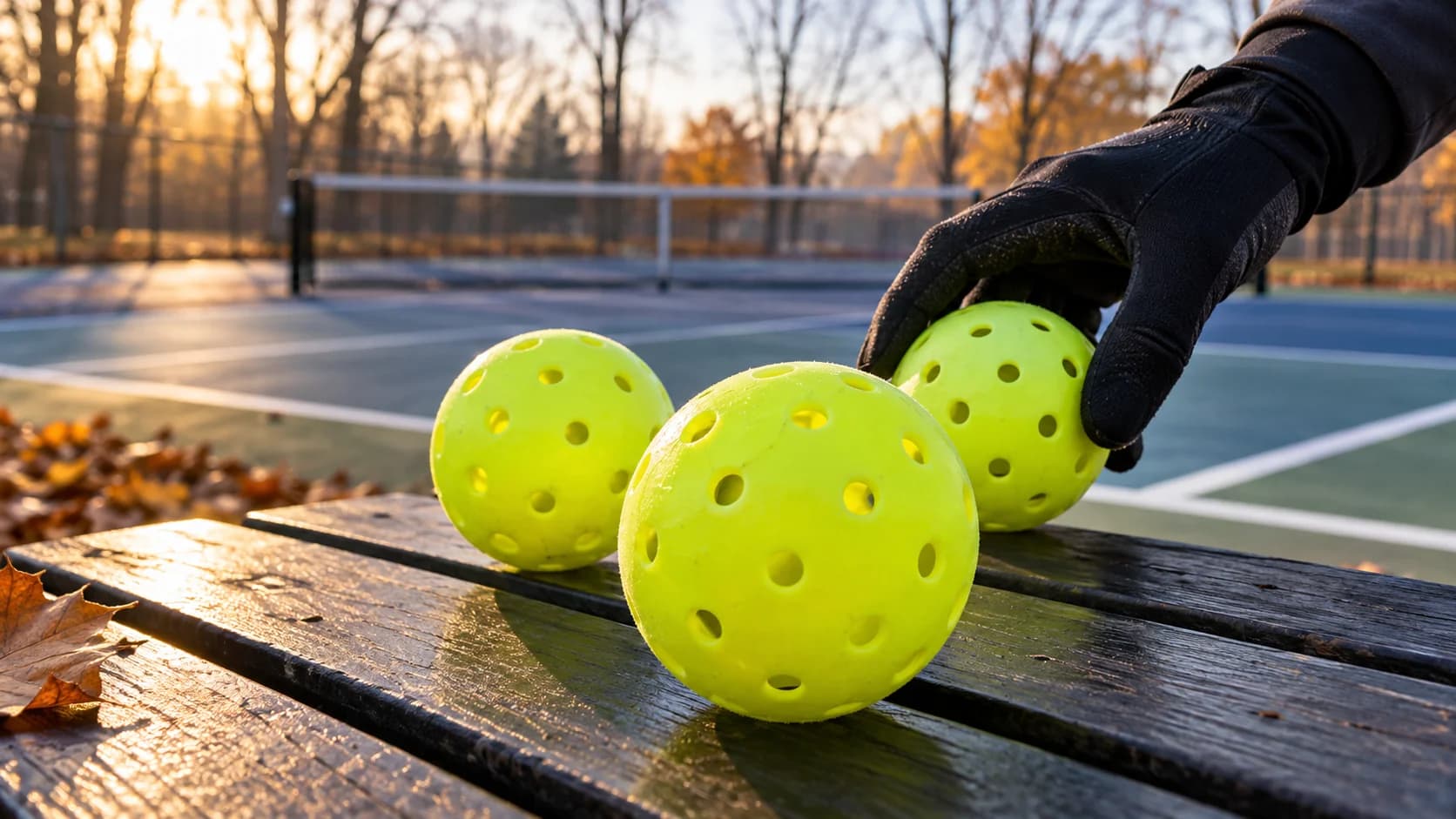
If your fall pickleballs keep cracking, start by comparing the ONIX Fuse G2, Selkirk Pro S1, and GAMMA CHUCK. Each has a manufacturer-backed reason to investigate for cooler outdoor play. None comes with evidence here that it will survive every winter session, and none should be called “unbreakable.”
The useful question is which ball suits your group’s game and gives you acceptable value after replacements. A ball that lasts longer but changes the feel of every rally is a different purchase decision from a direct replacement for your usual tournament ball.
As an Amazon Associate, AthleteXpert earns from qualifying purchases. This article contains affiliate links.
How we selected: manufacturer cold-weather guidance, construction descriptions, warranty terms, and verified product identities. AthleteXpert has not conducted a controlled cold-weather durability test. This is a buying shortlist, not a measured ranking of ball life, bounce, or crack resistance.
Quick comparison: three balls, three reasons to investigate
| Ball | Why it made the shortlist | The buying caveat |
|---|---|---|
| ONIX Fuse G2 Outdoor | ONIX explicitly recommends it in its cold-weather guidance | Try its softer material and playing feel with your group first |
| Selkirk Pro S1 | Crack-resistant construction claims and a published one-year no-crack warranty | The warranty has seller, purchase, claim, and damage restrictions |
| GAMMA CHUCK Outdoor | GAMMA markets its material for hot and cold conditions | The manufacturer claim does not establish an independently verified temperature limit |
Start with a small pack of one candidate. Have the people you actually play with use it in your normal conditions before anyone orders a bucket. Buying three competing bulk packs is an expensive way to discover that the group only wants one familiar ball.
1. ONIX Fuse G2: the most direct manufacturer cold-weather recommendation
ONIX’s cold-weather guide recommends the Fuse G2 and describes its material as softer, including in temperatures below 50°F. Its product description identifies welded seams and an outdoor design. Those are manufacturer statements, rather than proof of a guaranteed lifespan at a particular temperature.
Compare it if: your recreational group is willing to try a different feel to address winter replacement costs. Skip the bulk pack if: everyone wants an exact match for the ball used at your next event. A softer-material ball deserves a group trial before becoming the default.
Check that the listing says Fuse G2 Outdoor. ONIX also sells Fuse Indoor balls; the names are close enough to make a hurried purchase easy to get wrong.
Check ONIX Fuse G2 Outdoor balls on Amazon
2. Selkirk Pro S1: compare the warranty as carefully as the ball
The Selkirk Pro S1 uses a 38-hole design and is marketed for crack resistance. Its main point of difference for this comparison is a published warranty. A warranty is a remedy for an eligible failure; it does not mean a ball cannot crack or lose its shape.
Under the terms checked October 7, 2026, the one-year no-crack policy is for eligible US retail buyers purchasing from Selkirk or an authorized US retailer. A claim requires at least four defective balls and a receipt. Discounted purchases and specified event, club, program, and facility purchases are excluded; normal wear and balls that go out of round are not covered. The page lists a $6 processing fee, subject to change.
Compare it if: you want to evaluate a ball with a documented crack policy and can meet its conditions. Keep looking if: your main concern is maintaining roundness, or you expect the policy to cover a discounted club order. Check the actual Amazon seller’s authorization before treating warranty coverage as part of the value.
Read the AthleteXpert Pro S1 catalog entry.
Check Selkirk Pro S1 balls on Amazon
3. GAMMA CHUCK: an alternative with an explicit all-weather claim
GAMMA describes its CHUCK Outdoor ball as polypropylene with a symmetrical 38-hole pattern and claims resistance to warping and cracking in heat and cold. That earns it a place to compare. It does not let us assign a lowest safe temperature or promise a fixed number of games.
Compare it if: you want a third outdoor option with a specific temperature-related manufacturer claim. Skip it if: your club requires a different ball or you want independently measured winter durability before changing models. Ask about the smallest suitable pack and trial it under the same conditions as your current ball.
Check CHUCK pack options at GAMMA. This is a manufacturer link; it does not carry our Amazon affiliate tag.
Five mistakes that make a winter ball purchase less useful
- Treating a temperature claim as a guarantee. A manufacturer’s cold-weather recommendation is helpful evidence. It is not a head-to-head test of every ball under identical conditions.
- Buying the wrong indoor/outdoor version. Match the ball to the actual court and your group’s rules. A roof over an acrylic court does not make it a hardwood gym.
- Buying in bulk before checking the feel. The cheapest pack per ball can be a poor purchase if your group dislikes playing with it.
- Comparing sticker prices across different packs. Divide the final pack price by the number of balls. Keep shipping, seller terms, and warranty eligibility in view.
- Keeping a misshapen ball because it has no visible crack. Inspect for splits, dents, and obvious unevenness, then agree on a replacement if its bounce or flight becomes inconsistent.
A better value check than “cost per ball”
Cost per ball is the first calculation. Cost per usable session is the one your group can learn from. Keep a short note of the model, conditions, court, and how many sessions it remains acceptable. Your notes will not prove a universal durability ranking, but they can improve your next purchase.
For an illustration, suppose Pack A costs $18 for six balls and Pack B costs $24 for six. Their costs per ball are $3 and $4. If, in your own usage, A averages two acceptable sessions per ball and B averages four, the observed costs are $1.50 and $1 per session. These numbers are hypothetical, not prices or performance claims for any ball in this article.
Use the same standard for “acceptable” with both packs. Include shape and playing feel, rather than counting only cracks. Do not assume a warranty claim will erase every replacement expense.
Should you replace your Franklin X-40 just because it is fall?
No. If your current ball is holding up and your group likes it, the calendar is a weak reason to change. The Franklin X-40 catalog entry is useful when comparing the exact replacement model. This article does not establish that the X-40 always fails below a certain temperature or that one of our candidates always outlasts it.
Switching becomes worth investigating when you have a recurring problem: frequent cracking, a replacement expense you want to reduce, or a group willing to try a different feel. Keep event preparation separate from a casual durability experiment.
Can you use these balls in an indoor basketball gym?
Do not assume so. Ask which ball the facility or organizer uses on its floor. If the group specifies an indoor ball, compare that exact model. The ONIX Fuse Indoor catalog entry is a different product from the Fuse G2 Outdoor pick above.
If your winter plan is moving into a gym, our indoor pickleball shoe guide explains the floor and footwear checks. For home practice, see our solo pickleball practice list.
Before league or tournament play
Confirm the organizer’s specified ball and check the exact model on the USA Pickleball approved-ball list when approval matters. A logo in an old listing is not a substitute for a current equipment check. This article does not certify current tournament eligibility.
Research checked: October 7, 2026. Start with Fuse G2 for ONIX’s explicit cold-weather guidance, investigate Pro S1 if its warranty conditions matter to you, and compare CHUCK as an all-weather alternative. Let your group’s actual experience decide the repeat order.