Loading, please wait...
Weight Training
2-Day Planet Fitness Workout Plan: Machines Only + Free PDF
Start lifting twice a week with a beginner Planet Fitness machine workout, clear progression, equipment alternatives, and a free printable plan and log.
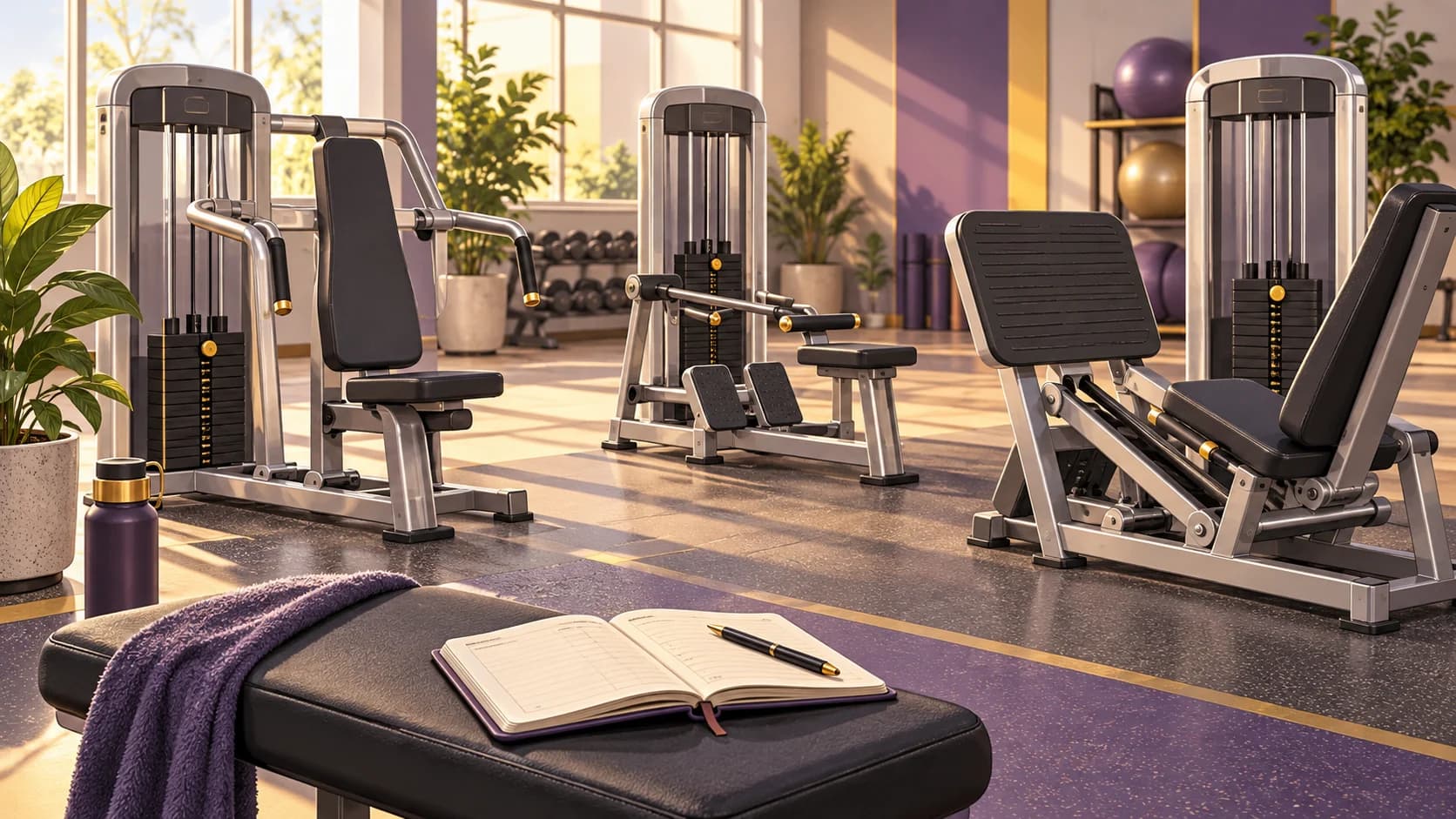
Two gym visits can be a useful training week. This 2-day Planet Fitness workout plan gives beginners two full-body sessions using weight machines, a clear way to choose the resistance, and a simple rule for getting stronger. Start with Workout A and Workout B on separate days, such as Monday and Thursday.
You will repeat a small group of movements instead of learning a new routine every visit. The aim is to leave knowing what you did and what to try next time. Allow roughly 40–55 minutes once you know the equipment; your first visits and a busy gym can take longer. That is a planning estimate, not a timed test.
Take it with you: Download the free three-page workout plan, progression guide, and reusable training log (PDF). No email signup is required.
This is an independent AthleteXpert training template for generally healthy adult beginners and returning exercisers. Planet Fitness has not endorsed it. Ask a qualified fitness professional to check unfamiliar machine settings and technique. An injury, recent surgery, or a medical restriction calls for individual guidance before using a general plan.
Your two-day workout week at a glance
- Schedule: Workout A on Monday and Workout B on Thursday, or another pair of days with at least one full rest day between lifting sessions.
- First two weeks: one working set of each of the seven exercises. Repeat this starting phase if you need more time to learn the movements.
- Weeks three to eight: use the set counts in the tables when technique and recovery are comfortable.
- Effort: finish a set while you could still perform about two or three more controlled repetitions. Repetitions are individual movements; a set is one group of them.
- Rest: 90–120 seconds between working sets. Take longer when you need it to regain comfortable breathing and control.
- Equipment: leg press, leg curl, chest press, seated row, lat pulldown, shoulder press, and abdominal crunch machines. Club equipment and adjustment systems vary.
On other days, walk, cycle, play your sport, or follow your usual aerobic routine at a manageable effort. These two lifting sessions address strength training; they do not replace the aerobic part of a balanced activity plan.
Before the first set: learn the machine and find your starting weight
Begin with five to ten minutes of comfortable walking or cycling. Then rehearse the first leg and upper-body movements with a lighter resistance before the working sets. Warm-up sets do not count toward the table totals.
For each unfamiliar machine, read its instructions and ask staff about the seat, pads, starting position, and adjustment pin. Record the settings in your log. Planet Fitness describes machine instruction through its PE@PF training program; check availability at your club.
Start lighter than you think you need. Try the bottom of the listed repetition range, stop, and assess: could you do several more smooth repetitions without changing your position? If yes, that is a reasonable learning load. If the last repetition involves swinging, lifting off the seat, or straining to finish, reduce the resistance.
A stack marked “40” on one machine is not necessarily equivalent to “40” on another. Pulleys, lever arms, and starting resistance differ. Compare your performance on the same machine with the same settings, and establish a new baseline when switching models.
Keep breathing through each repetition. Use a controlled movement and a comfortable range without bouncing or slamming the stack. Stop an exercise that causes pain. These principles follow Mayo Clinic's weight-training technique guidance; a written cue cannot check your form.
Workout A: your first full-body machine session
Complete one exercise's sets before moving to the next machine. The table shows the regular prescription for weeks three to eight. In weeks one and two, do just one working set per row.
| Exercise, in order | Sets × reps | Setup and movement cue |
|---|---|---|
| Seated leg press | 2 × 8–12 | Keep your back and pelvis supported, feet flat on the platform, and knees tracking with your toes. Use a depth you can control without your pelvis rolling away from the pad. |
| Machine chest press | 2 × 8–12 | Adjust the seat so the handles sit around mid-chest. Keep your back against the pad and press without forcing your elbows into a hard lock. |
| Seated row machine | 2 × 8–12 | Keep your torso steady and any chest pad comfortably positioned. Pull the handles toward your ribs without rocking backward. |
| Seated or lying leg curl | 2 × 10–15 | Ask staff to align the knee pivot and pads. Bend your knees through a comfortable range while keeping your hips supported. |
| Lat pulldown | 1 × 10–15 | Secure the thigh pad. Pull in front of your head toward your upper chest, using a comfortable grip and a steady torso. |
| Machine shoulder press | 1 × 8–12 | Set the seat so you can reach the handles without an awkward stretch. Keep your back supported and avoid excessive arching. |
| Abdominal crunch machine | 1 × 10–15 | Follow the machine's setup instructions. Use light resistance and a small controlled trunk curl rather than pulling hard with your arms. |
Rest 90–120 seconds between working sets, and settle into the next station before beginning. The leg press works the thighs and hips; the leg curl gives the hamstrings dedicated work. The presses and pulls involve your chest, shoulders, back, and arms. The final movement adds direct abdominal work.
Workout B: the second full-body session
The familiar equipment is intentional. Workout B changes the order and gives the pulldown a second set, while the row drops to one. You can practice the same skills and track progress without learning a separate gym's worth of exercises.
| Exercise, in order | Sets × reps | Focus for this visit |
|---|---|---|
| Seated or lying leg curl | 2 × 10–15 | Repeat the recorded setup; keep your hips still as you bend your knees. |
| Seated leg press | 2 × 8–12 | Use the same foot position and controlled depth as Workout A. |
| Lat pulldown | 2 × 10–15 | Keep the bar in front of your head and control its return upward. |
| Machine chest press | 2 × 8–12 | Repeat your seat setting and keep each repetition smooth. |
| Seated row machine | 1 × 8–12 | One controlled set; avoid adding momentum to lift more weight. |
| Machine shoulder press | 1 × 8–12 | Keep your back supported and use a comfortable pressing range. |
| Abdominal crunch machine | 1 × 10–15 | Finish with the same light, controlled technique as Workout A. |
If you want direct calf work and have recovered comfortably, add one or two sets of 12–20 repetitions on a dedicated calf machine, following its instructions. This is optional and adds time. Avoid improvising a calf exercise on equipment you have not learned to use.
Machine taken? Use this backup plan
Work through another exercise that is available, then return. Keep your planned rest and use one station at a time. If you change machines, start with a light practice set and find the appropriate resistance again.
| Planned station | Backup | What to check |
|---|---|---|
| Seated leg press | Another leg press model, after an orientation | A plate-loaded or angled version can have substantial starting resistance. If no familiar version is available, reorder the session and return; a leg extension alone does not replace the whole movement. |
| Leg curl | Seated curl for lying curl, or the reverse | Learn the new knee-pivot and pad settings. Treat its weight as a new baseline. |
| Chest press | Another flat or incline chest-press machine | The angle and load will feel different. A pec deck is a different exercise, so it is not a complete replacement for the press. |
| Seated row | Another row machine or a familiar seated cable row | Use the intended seat and foot supports. Keep the torso steady and the cable path clear. |
| Lat pulldown | Another pulldown model; assisted pull-up only after instruction | On an assisted pull-up machine, more assistance makes the exercise easier. Its number is not a load to copy from the pulldown. |
| Shoulder press | Another familiar shoulder-press machine | If none is available, return later or omit this accessory for that visit. Avoid forcing an unfamiliar overhead variation. |
| Abdominal crunch | Another familiar abdominal-crunch machine | If none is available, return later or omit this accessory once. A rotary-torso machine performs a different movement. |
Equipment availability varies by location, including at clubs undergoing changes. Confirm the seven stations before committing to the plan. If a main movement is consistently missing, ask a qualified trainer to adapt the template around your club's actual equipment.
Your eight-week progression: earn the next increase
Use the calendar to build a routine. Use your repetitions, control, and recovery to decide when to progress. A new week does not automatically require a heavier weight.
| Week | What to do in both sessions |
|---|---|
| 1 | Learn all seven stations. Do one working set per exercise with several controlled repetitions still available. Record the machine and seat settings. |
| 2 | Repeat one set per exercise. Adjust starting loads if needed; keep the same machines and movement range. |
| 3 | If technique and recovery are comfortable, use the full A/B table set counts. Keep the loads steady while adding sets. |
| 4 | Keep the set counts. Add a repetition where you can while retaining about two or three good repetitions in reserve. |
| 5 | Increase a machine's resistance only when you meet the progression rule below. Other machines can stay at the same weight. |
| 6 | Repeat the process. Keep separate records for different machines and for the A/B exercise order. |
| 7 | Continue when recovery is good. If accumulated fatigue affects technique, use the easier-week option below. |
| 8 | Compare your records with the starting weeks. Repeat another block if it remains useful; seek a revised program when your goals or schedule change. |
The progression rule: reach the top of an exercise's rep range on every prescribed set, with consistent form and about two or three repetitions still available, on two comparable visits. Then try the smallest available resistance increase. Return toward the bottom of the rep range as needed. If you cannot reach that lower limit cleanly, return to the previous load.
For example, on a two-set 8–12 exercise, 12 and 10 repetitions means keep practicing at that weight. Two sets of 12 on two comparable visits can justify trying the next increment. This is an example of the decision rule, not a requirement to progress at a fixed rate.
If the next stack increment is too large, keep your current resistance and improve consistency. Ask staff about approved adjustment options; do not attach improvised weights to the machine. For an easier week, return to one set per exercise and choose a comfortable load. Resume regular volume when recovered. Persistent fatigue or pain deserves individual assessment.
Is lifting twice a week enough to build muscle?
Two full-body lifting sessions per week can improve strength and support muscle growth, particularly for beginners. Results depend on a suitable training stimulus, progression, nutrition, recovery, and consistency. Two days describes the schedule; the work you perform within those sessions matters.
The 2026 ACSM position stand supports progressive resistance training and reports that equipment type did not consistently change outcomes. Its practical message is that multiple approaches can work. It also identifies higher weekly training volume as a way to enhance hypertrophy. This relatively modest starter plan is therefore a manageable entry point, rather than a claim to maximize muscle growth.
You do not need to push every set to the point where another repetition becomes impossible. Learn repeatable technique and a sensible effort level first. Add training volume later when your experience, goals, available time, and recovery justify it.
How this differs from the Planet Fitness 30-minute circuit
Planet Fitness describes its 30-Minute Express Circuit as strength machines alternating with cardio-step stations on timed signals. This A/B plan uses counted repetitions, sets, and rest periods with a training log. The formats serve different preferences.
If you use machines inside a designated circuit area, follow that area's timing and rules. Ask staff where to perform a set-based workout without interrupting other members. Do not reserve the circuit stations for this routine.
What should you bring?
Bring your plan, a way to record the sets, water, and footwear that fits securely. Record the machine model, seat and pad positions, resistance, completed repetitions, and any discomfort. A note such as “chest press, seat 4, same weight, 10/10” is more useful than trying to remember whether the visit felt hard.
Before buying anything, check what you already own. Our Reebok Nano Gym 2.0 vs. Nano X5 comparison explains two training-shoe options, while our budget high-protein foods guide helps compare ordinary food choices. Some linked buying guides contain affiliate links; as an Amazon Associate, AthleteXpert earns from qualifying purchases.
Questions before your first workout
Can I build muscle at Planet Fitness using only machines?
Yes. Machines can provide progressively challenging resistance for major muscle groups. Your exercise selection, effort, consistency, and recovery matter. A membership alone does not determine the outcome, and this beginner template is not a promise of a particular physique.
Should I do Workout A and Workout B on consecutive days?
For this plan, separate them with at least one full rest day. Monday and Thursday or Tuesday and Friday are straightforward examples. If you miss a visit, continue with the next scheduled session instead of doubling the work.
How much weight should a beginner use?
Choose resistance you can control within the listed repetition range while leaving several good repetitions available. There is no single correct starting weight based on sex, age, or body weight. Machine design and your current ability affect the appropriate setting.
What if I only have 30 minutes?
Use the introductory version with one set per exercise, keep a sensible warm-up, and rest as needed. Omit optional calf work. If equipment queues prevent completion, record what you managed and allow more time next visit. Avoid racing through repetitions to satisfy the clock.
Can I use this alongside running or HYROX training?
Potentially, but count all of your training when judging recovery. Keep an easy day between a demanding leg session and a hard run when possible. Our Planet Fitness HYROX guide offers a separate race-focused template. Choose one primary schedule and adapt it; simply stacking both plans adds considerable work.
Save the plan and make the next visit easier
Get the free printable workout and log, choose your two training days, and ask staff to help you learn the first machine. After each visit, write down what happened. The next useful target might be a better setup, another controlled repetition, or a small resistance increase.
Find more lifting content in the AthleteXpert Weight Training sector.
Sources and editorial method
This original template draws on the ACSM resistance-training review, general technique guidance, and Planet Fitness equipment resources. Its exact A/B exercise order and eight-week introduction are AthleteXpert editorial programming choices. They were not tested as a package in the cited research, and this article has not received an individual trainer assessment or a club walkthrough. The cover is an AI-generated editorial illustration, not a photograph of a particular location.
- ACSM: Resistance Training Prescription for Muscle Function, Hypertrophy, and Physical Performance in Healthy Adults (2026).
- Mayo Clinic: Weight training do's and don'ts of proper technique.
- Planet Fitness: PE@PF training and 30-Minute Express Circuit.
- Planet Fitness: leg-press machine guide.
- Planet Fitness: lat-pulldown instructions.
Sources checked October 31, 2026. Equipment and programs vary by club; verify your location's current setup.